EPC Vendors

EPC Vendors

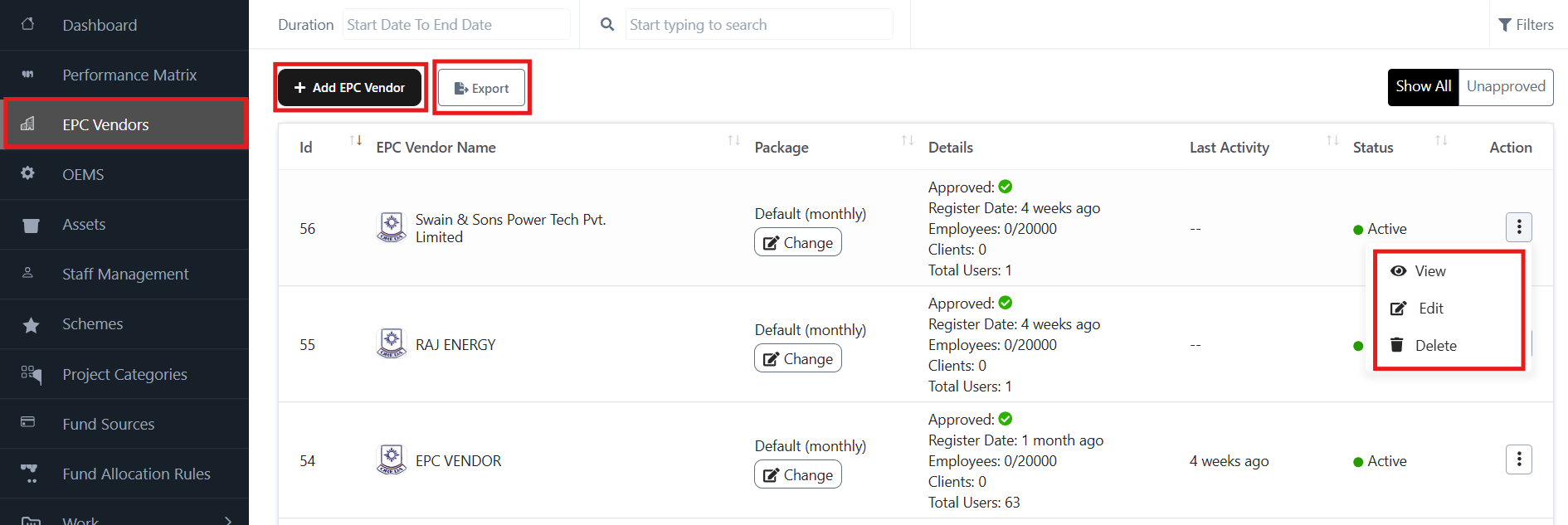
The EPC Vendors module allows administrators to manage Engineering, Procurement, and Construction (EPC) vendor information within SolarCRM. It provides functionalities to add new vendors, edit details, export vendor data, and manage vendor accounts.

Admin Dashboard → EPC Vendors

EPC Vendors

EPC Vendors Overview

The EPC Vendor page displays the list of registered vendor with details such as:

  • Vendor ID & Name
  • Package (Default monthly or custom package)
  • Approval & Registration Date
  • Employee & Client Counts
  • Status (Active/Inactive)
  • Last Activity

From this screen, admins can:

  • Add new EPC vendors
  • Export vendor data
  • View, Edit, or Delete vendor records

Adding a New EPC Vendor

  • Click Add EPC Vendor.
  • Fill in the Company Details:
    • Vendor Name (required)
    • Vendor Email (required)
    • Vendor Phone
    • Vendor Website
    • Default Currency
    • Default Timezone
    • Vendor Address
    • Upload Vendor Logo
    • Select Language and Status
  • Enter Account Details (for the first EPC vendor admin):
    • Admin Name (required)
    • Admin Email (required – login credentials will be sent here)
  • Click Save to create the EPC Vendor record.
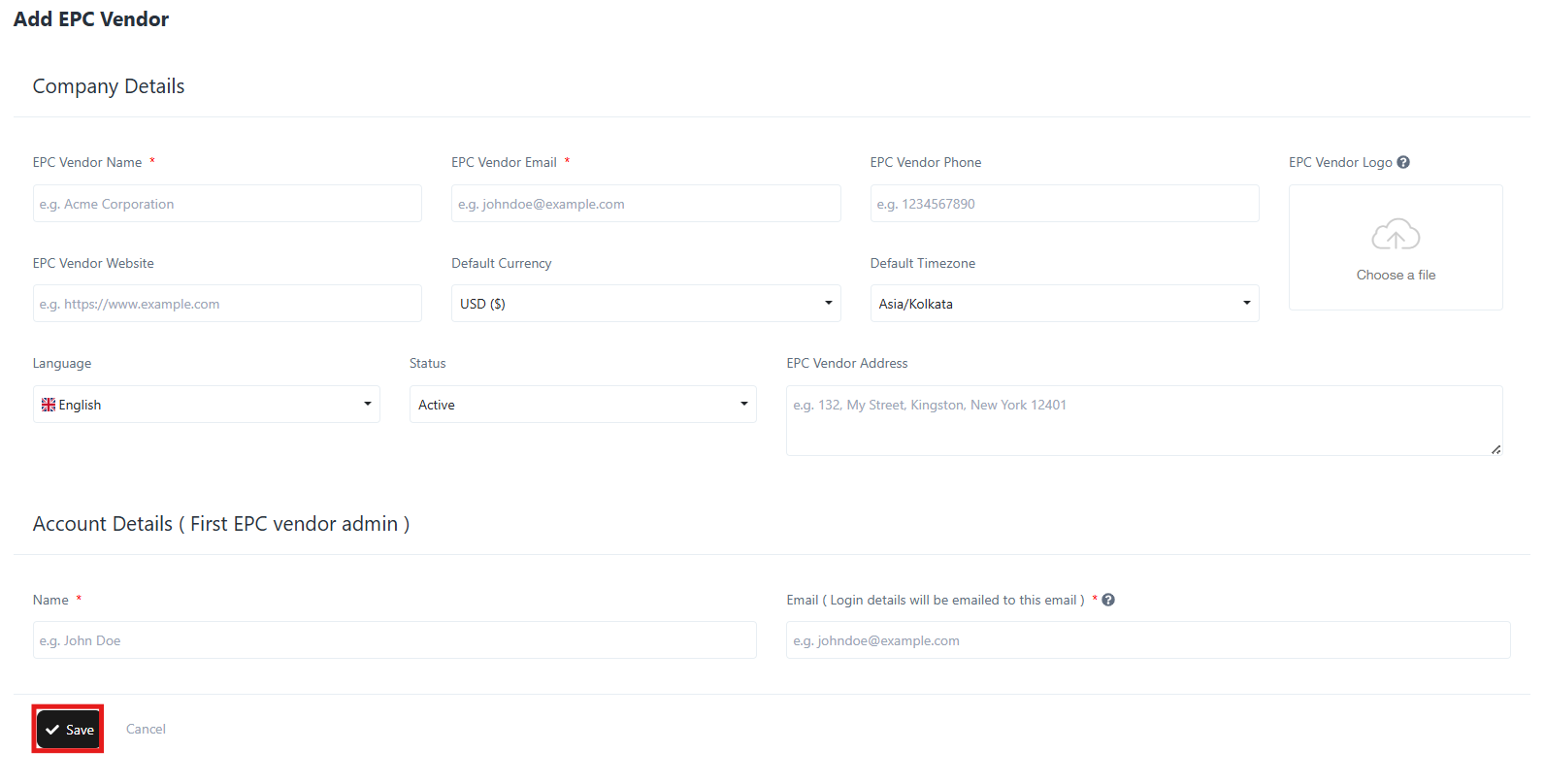
Adding a New EPC Vendor

Exporting EPC Vendors

  • Click Export on the EPC Vendor page to download the list of vendor.
  • Exported data can be used for offline reporting or compliance records.

Vendor Actions

For each vendor, the Action menu (three dots on the right side) provides options:

  • View → View vendor details.
  • Edit → Update vendor details such as contact info, package, or status.
  • Delete → Permanently remove a vendor from the system.

Vendor Status

  • Vendors can be marked Active or Inactive depending on their approval or engagement.
  • Status can be updated via the Edit option.

Key Benefits

  • Centralized EPC vendor database
  • Easy onboarding of new vendors
  • Export-ready vendor reports
  • Secure vendor admin login creation
Performance Matrix

Performance Matrix

The Performance Matrix module provides an in-depth analysis of EPC vendors’ performance, covering timeliness, quality compliance, satisfaction levels, fund utilization, and project completion ratios. It is designed to help administrators evaluate and rank vendors effectively.

1. Accessing Performance Matrix

  • From the left-hand navigation menu, click on Performance Matrix.
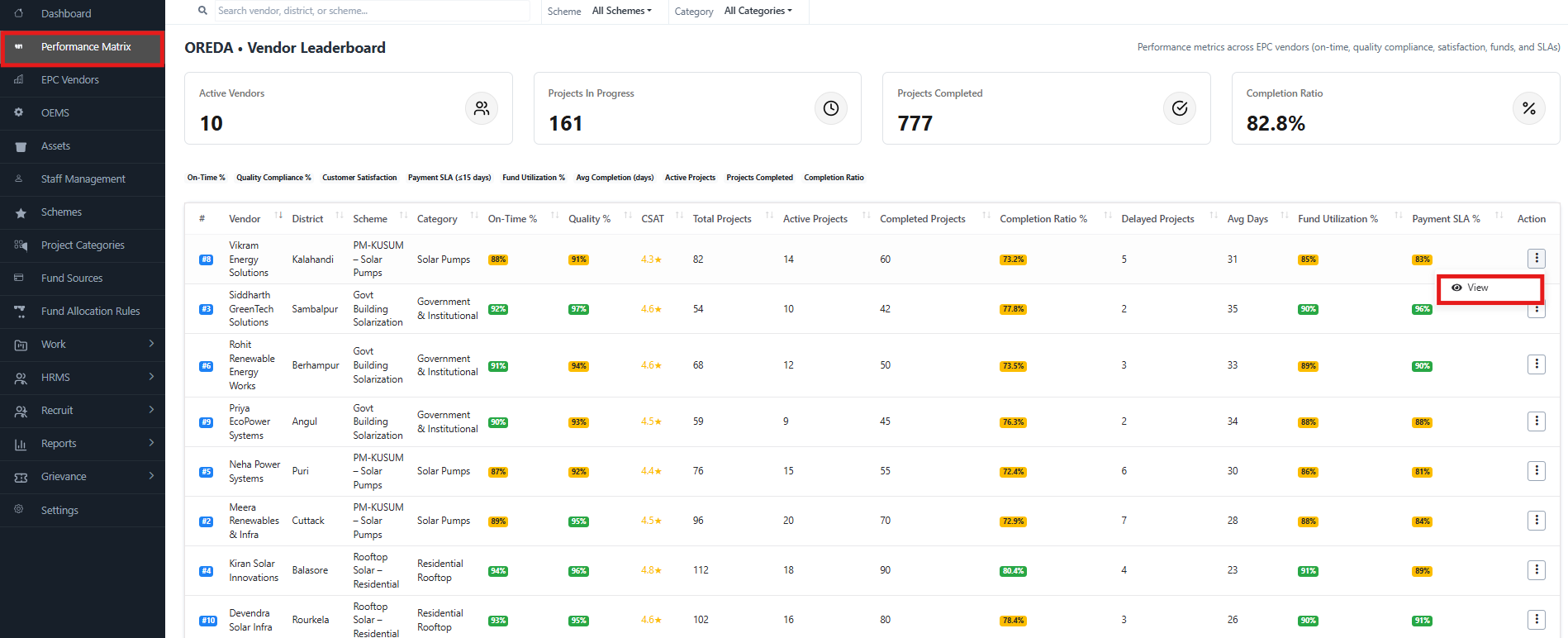
  • The screen displays the Vendor Leaderboard, along with performance indicators.

Performance Matrix

2. Key Metrics Overview (Top Panel)

At the top of the module, summary indicators are shown:

  • Active Vendors – The total number of EPC vendors currently working.
  • Projects In Progress – Ongoing projects under execution.
  • Projects Completed – Total number of successfully completed projects.
  • Completion Ratio (%) – Percentage of projects completed against assigned projects.

3. Vendor Leaderboard (Detailed Table)

The leaderboard ranks EPC vendors based on performance metrics.

Columns in the Leaderboard:

  • # (Rank) – Vendor’s rank based on performance.
  • Vendor – Name of the EPC vendor.
  • District – Location/district of the vendor’s projects.
  • Scheme – Scheme under which the vendor is executing projects (e.g., PM-KUSUM, Govt Building Solarization, Residential Rooftop).
  • Category – Project category (e.g., Solar Pumps, Government & Institutional, Residential Rooftop).
  • On-Time % – Percentage of projects completed within the scheduled timeline.
  • Quality % – Quality compliance percentage.
  • CSAT – Customer Satisfaction Score, represented in star ratings.
  • Total Projects – Number of total projects handled by the vendor.
  • Active Projects – Ongoing projects.
  • Completed Projects – Number of finished projects.
  • Completion Ratio % – Completed projects divided by total projects.
  • Delayed Projects – Projects delayed beyond the scheduled timeline.
  • Avg Days – Average number of days taken for completion.
  • Fund Utilization % – Percentage of allocated funds utilized by the vendor.
  • Payment SLA % – Adherence to payment Service Level Agreement timelines.

4. Actions

Each vendor row has an Action menu (⋮).

  • View – Opens detailed vendor performance reports, project data, and fund utilization.

5. Example Insights

From the screenshot:

  • Kiran Solar Innovations (#4):
    • On-Time %: 94%
    • Quality %: 96%
    • CSAT: 4.8★
    • Completion Ratio: 80.4% (highest in list)
  • Vikram Energy Solutions (#8):
    • On-Time %: 88%
    • Quality %: 91%
    • CSAT: 4.3★
    • Avg Days: 31

This allows Admins to benchmark vendor performance and take corrective actions.

6. Filters & Search Options

At the top, Admins can refine results using filters:

  • Scheme filter – View vendors by specific schemes.
  • Category filter – Narrow down by project categories.
  • Search bar – Search vendors, districts, or schemes directly.

Admin Dashboard

Admin Dashboard

The Admin Dashboard is the central monitoring and control panel for administrators in SolarCRM. It provides a consolidated view of schemes, projects, vendors, funds, and overall performance metrics.

To access the Admin Dashboard, follow this path:

Login → Admin Portal → Left Menu → Dashboard

Admin Dashboard

1. Dashboard Overview

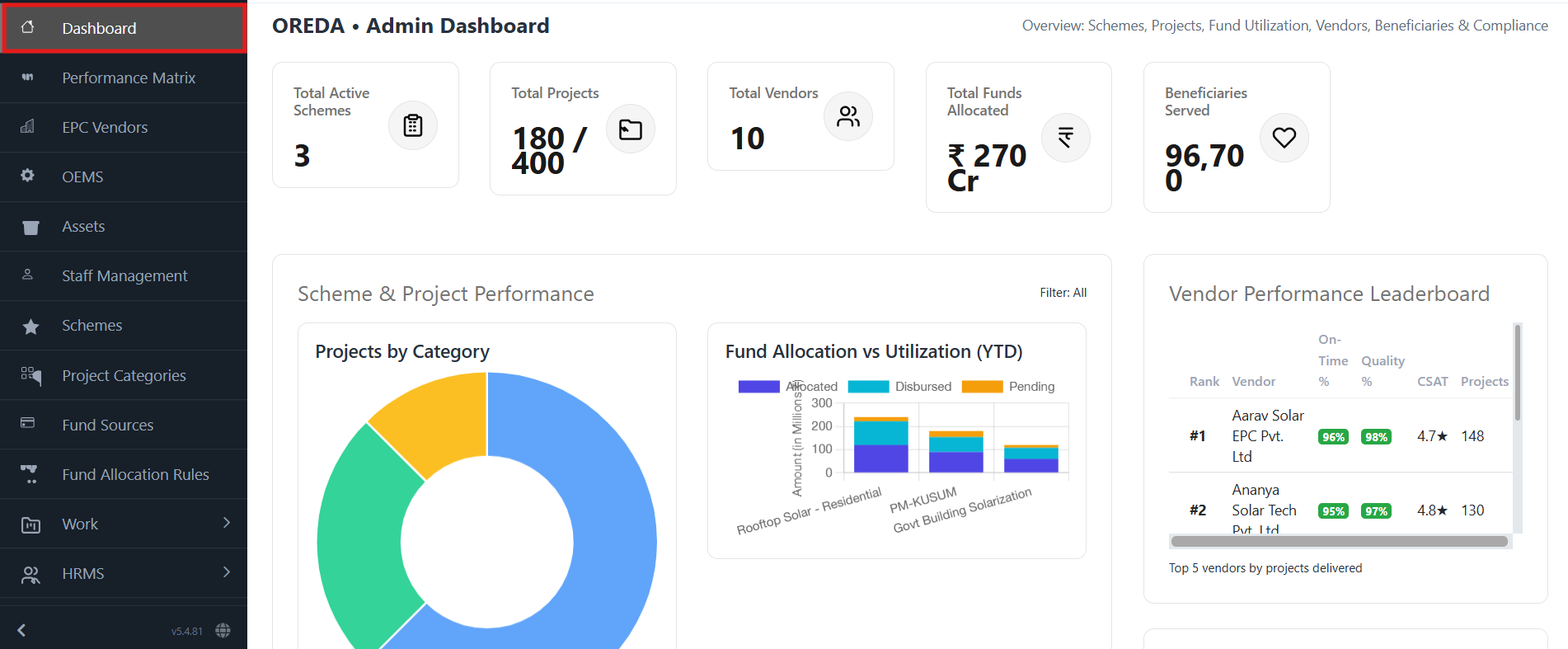
When you log in as an Admin, the Dashboard is the first screen displayed. It gives a real-time summary of key performance indicators.

Dashboard Highlights:

  • Total Active Schemes – Number of ongoing schemes.
  • Total Projects – Displays both completed and ongoing projects against total assigned projects.
  • Total Vendors – The total number of EPC vendors currently registered.
  • Total Funds Allocated – Shows overall funds allocated for all projects/schemes.
  • Beneficiaries Served – Indicates the total number of beneficiaries reached under different projects.

2. Scheme & Project Performance

This section provides insights into the scheme and project-level distribution and fund utilization.

  • Projects by Category (Pie Chart)

Visual breakdown of projects by categories such as Residential, Government, Commercial, etc.

  • Fund Allocation vs Utilization (YTD) (Bar Chart)

Compares funds allocated, disbursed, and pending across major project categories (e.g., Rooftop Solar, PM-KUSUM, Govt Building Solarization).

3. Vendor Performance Leaderboard

This leaderboard displays top-performing EPC vendors based on multiple performance metrics:

  • Rank – Vendor’s rank in performance.
  • Vendor Name – Name of the EPC Vendor.
  • On-Time % – Percentage of projects delivered on time.
  • Quality%  – Quality performance percentage.
  • CSAT (Customer Satisfaction Score) – Average customer rating.
  • Projects – Number of projects completed by the vendor.

Example:

  • #1 Aarav Solar EPC Pvt. Ltd – 96% on-time, 98% quality, 4.7★ CSAT, 148 projects.
  • #2 Ananya Solar Tech Pvt. Ltd – 95% on-time, 97% quality, 4.8★ CSAT, 130 projects.

4. Navigation Panel (Left Sidebar)

The left-hand navigation panel allows quick access to all admin modules:

  • Dashboard – Overview of all performance indicators.
  • Performance Matrix – In-depth vendor and project performance tracking.
  • EPC Vendors – Manage EPC vendor details.
  • OEMs – Manage Original Equipment Manufacturers.
  • Assets – Track project-related assets.
  • Staff Management – Manage user/staff profiles.
  • Schemes – Create and manage solar schemes.
  • Project Categories – Categorize and group projects.
  • Fund Sources – Define and track funding sources.
  • Fund Allocation Rules – Set rules for fund allocation and disbursement.
  • Work & HRMS – Manage work allocation and staff HRMS.

5. Actions You Can Perform

  • Monitor active schemes, projects, vendors, and beneficiaries.
  • Compare allocated vs utilized funds.
  • Track vendor rankings and identify top performers.
  • Use filters for deeper insights (e.g., by scheme, category, or year).
  • Navigate to detailed modules for more granular actions.

Financial Plans

Financial Plans

The Financial Plans module allows you to add, edit, view, and manage various financial plans for solar projects.

Accessing Financial Plans

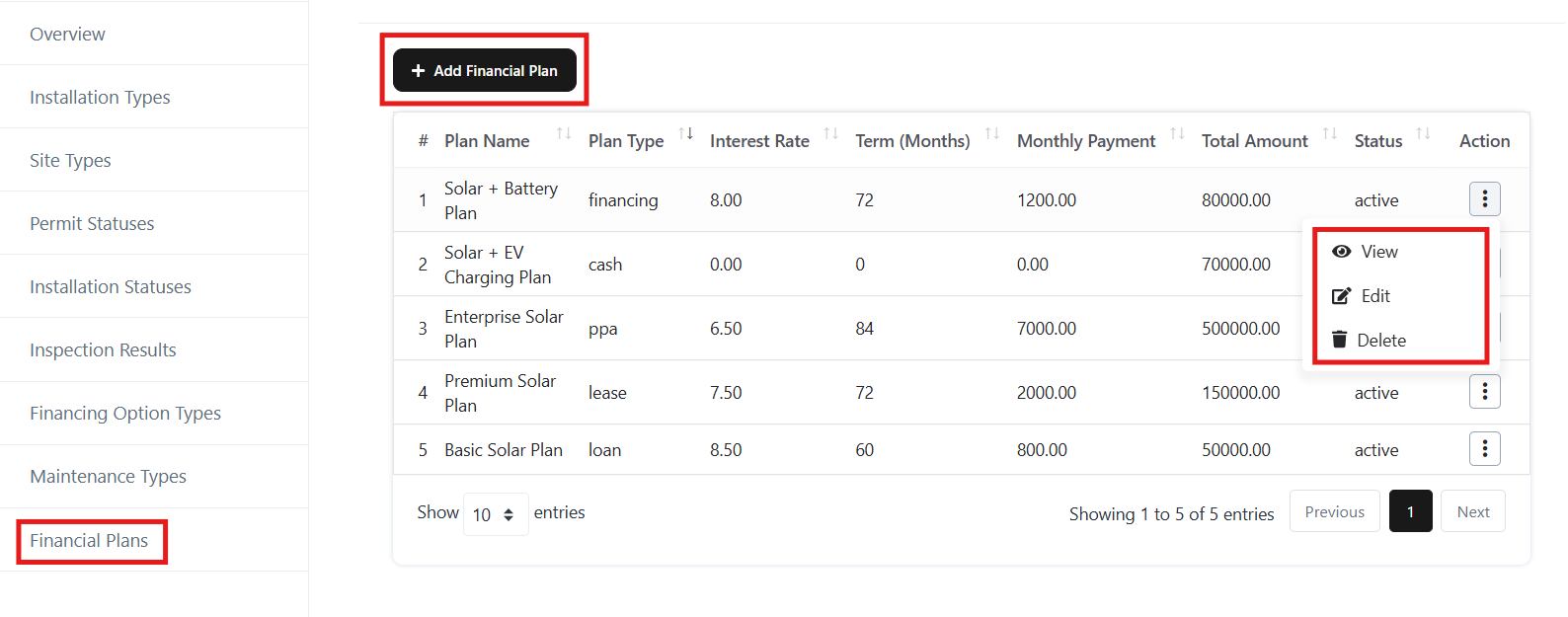
  • Navigate to the Solar > Settings > Financial Plan section from the left menu.
  • A list of existing financial plan will be displayed with details such as:
    • Plan Name
    • Plan Type
    • Interest Rate
    • Term (Months)
    • Monthly Payment
    • Total Amount
    • Status

Accessing Financial Plans

Add a Financial Plan

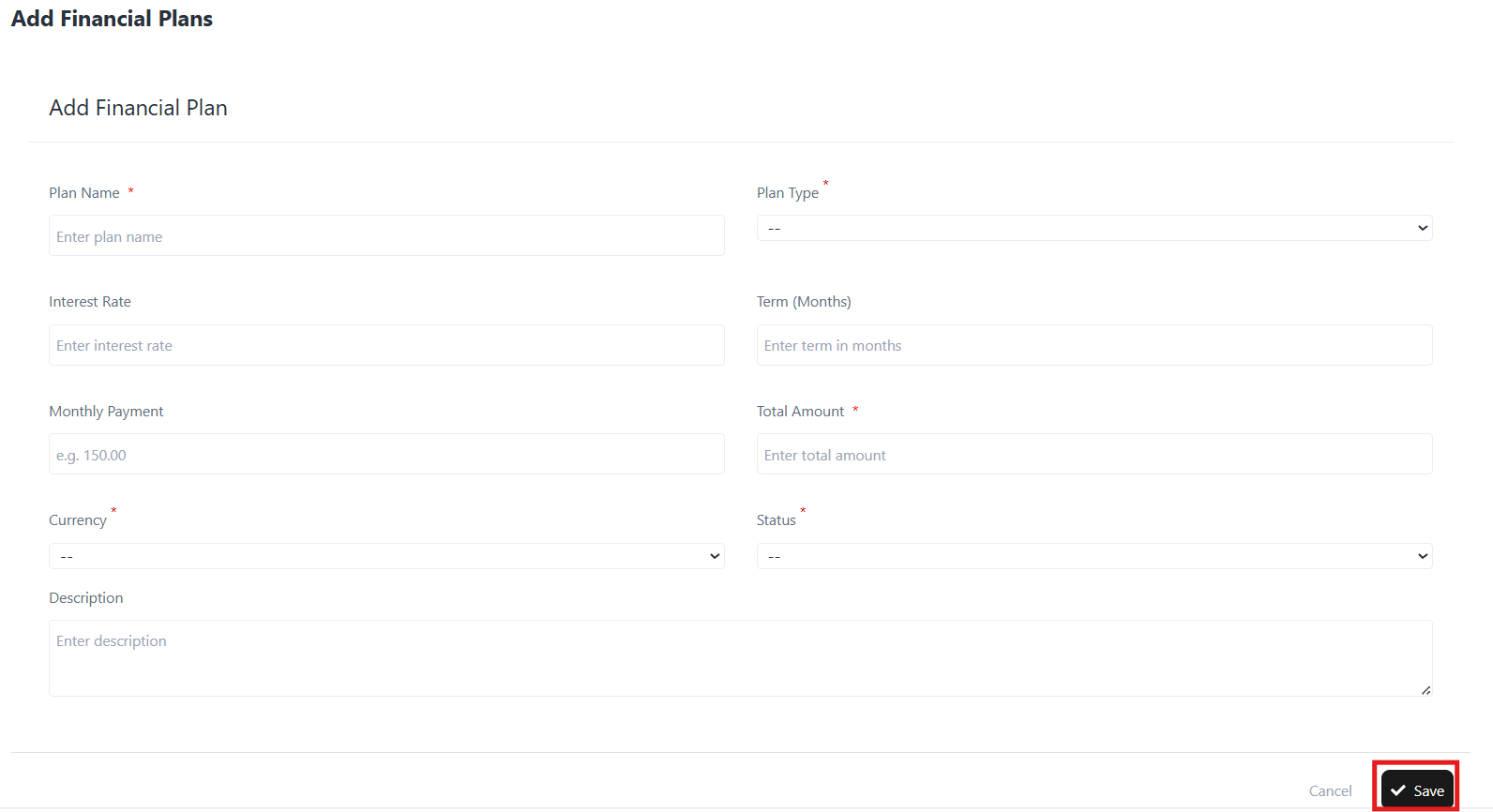
  • Click the + Add Financial Plan button at the top.
  • Fill in the following details:
    • Plan Name – Enter the name of the plan.
    • Plan Type – Choose the plan type (e.g., financing, lease, loan, PPA, cash).
    • Interest Rate – Input the interest rate for the plan.
    • Term (Months) – Enter the duration of the plan in months.
    • Monthly Payment – Define the monthly installment.
    • Total Amount – Enter the total payable amount.
    • Currency – Select the applicable currency.
    • Status – Set the plan as Active or Inactive.
    • Description – Provide a short explanation of the plan.
  • Click Save to create the plan.

Add a Financial Plan

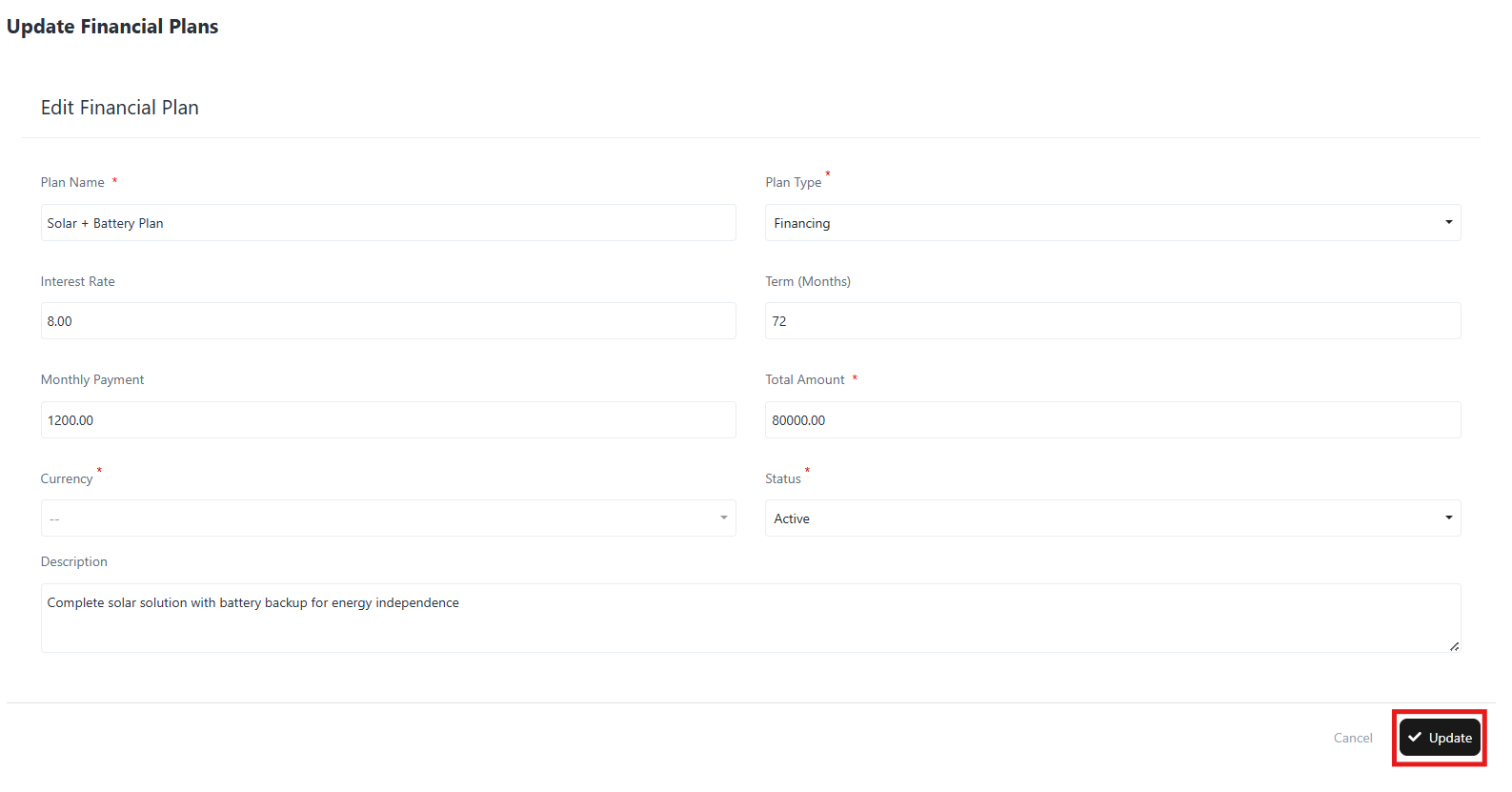
Edit a Financial Plan

  • In the Financial Plan list, click the three-dot menu under the Action column for the desired plan.
  • Select Edit.
  • Update any of the details:
    • Plan Name, Plan Type, Interest Rate, Term, Monthly Payment, Total Amount, Currency, Status, or Description.
  • Click Update to save changes.

Edit a Financial Plan

View a Financial Plan

  • Click the three-dot menu under the Action column.
  • Select View.
  • The system displays detailed plan information including:
    • Plan Name
    • Plan Type
    • Interest Rate
    • Term (Months)
    • Monthly Payment
    • Total Amount
    • Status
    • Description
    • Created Date

Delete a Financial Plan

  • Click the three-dot menu next to the financial plan.
  • Select Delete.
  • Confirm the deletion when prompted.

Financing Option

Financing Option

This guide explains how to manage Financing Option Types in the system. You can addedit, or delete different financing options to match your project requirements.

1. Accessing Financing Option Types

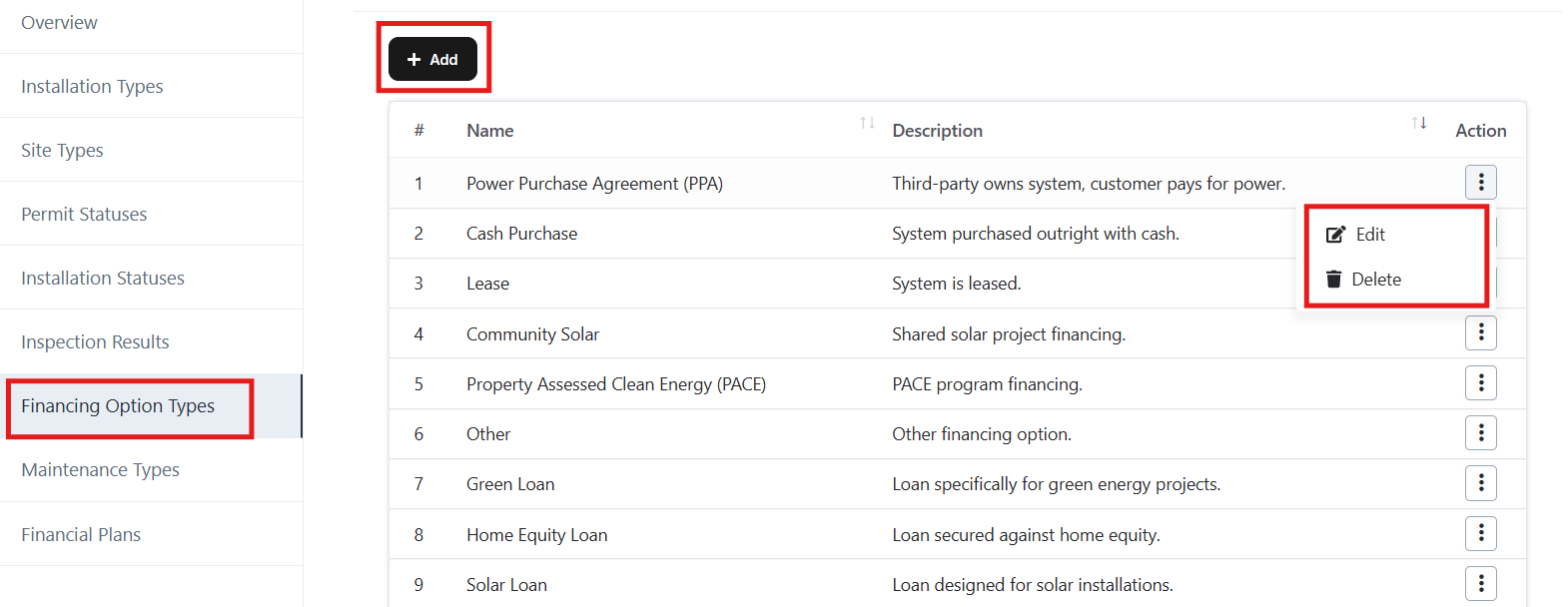
  • From the left sidebar menu, go to Settings → Financing Options Types.
  • A list of existing financing options will be displayed with columns for:
    • # – Serial number of the entry.
    • Name – Financing options name.
    • Description – A short explanation of the option.
    • Action – Options to Edit or Delete.

Accessing Financing Option Types

2. Adding a Financing Option Type

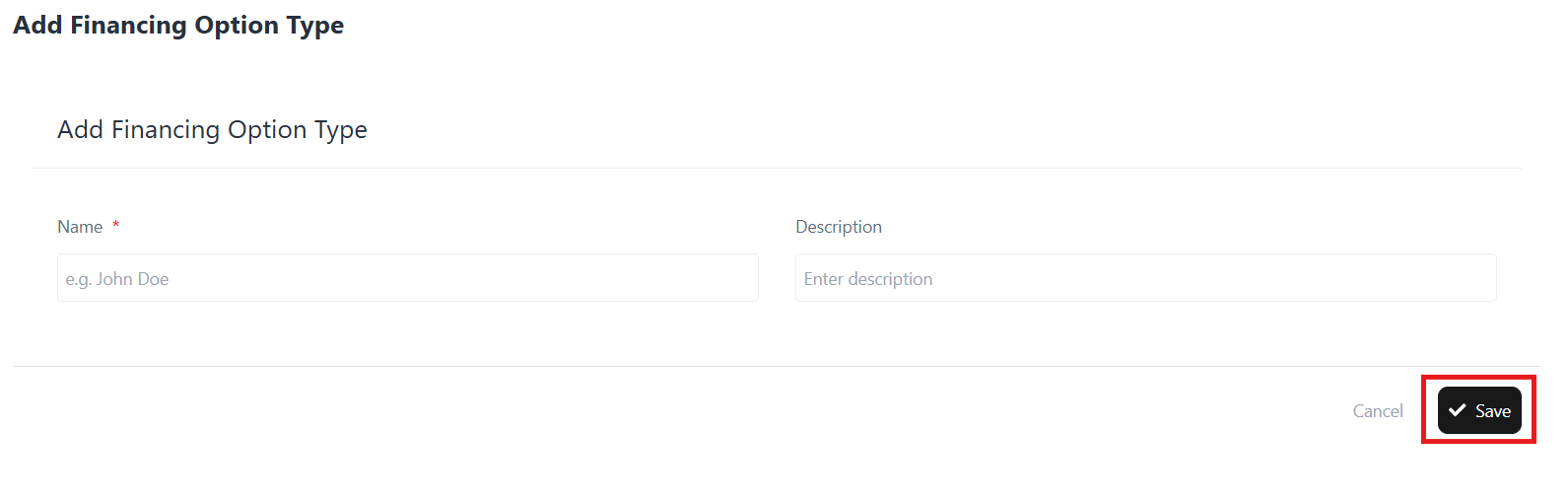
  • Click the + Add button at the top.
  • The Add Financing Options Type form will open.
  • Enter the following details:
    • Name (Required) → Example: Cash Purchase, Lease, Green Loan.
    • Description → Short explanation of the financing options.
  • Click Save to add the new financing options.

Adding a Financing Option Type

3. Editing a Financing Option Type

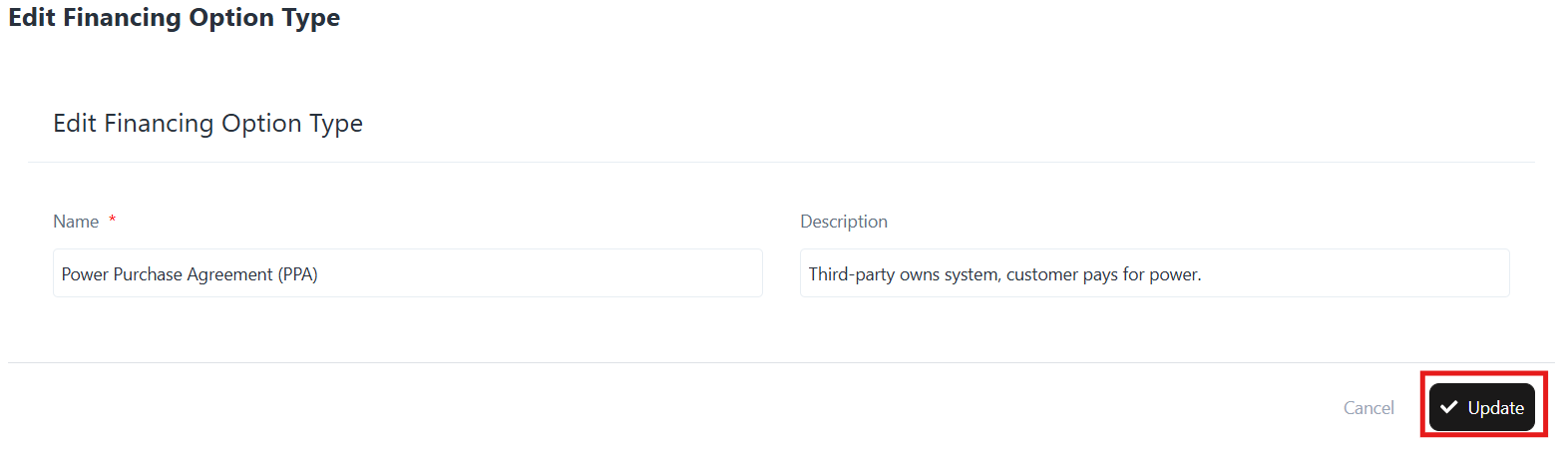
  • In the Action column, click the three dots (…) beside the financing options you want to update.
  • Select Edit.
  • The Edit Financing Options Type form will appear.
  • Modify the Name or Description as needed.
  • Click Update to save changes.

Editing a Financing Option Type

4. Deleting a Financing Option Type

  • In the Action column, click the three dots (…) beside the financing options you want to remove.
  • Select Delete.
  • Confirm the deletion when prompted.

Note: Once deleted, the option cannot be recovered.

5. Example Financing Options

  • Power Purchase Agreement (PPA): Third-party owns system, customer pays for power.
  • Cash Purchase: System purchased outright with cash.
  • Lease: System is leased.
  • Community Solar: Shared solar project financing.
  • PACE (Property Assessed Clean Energy): Financing tied to property taxes.
  • Green Loan: A Loan for green energy projects.
  • Home Equity Loan: A Loan secured against home equity.
  • Solar Loan: A Loan designed for solar installations.

Inspection Results

Inspection Results

Overview

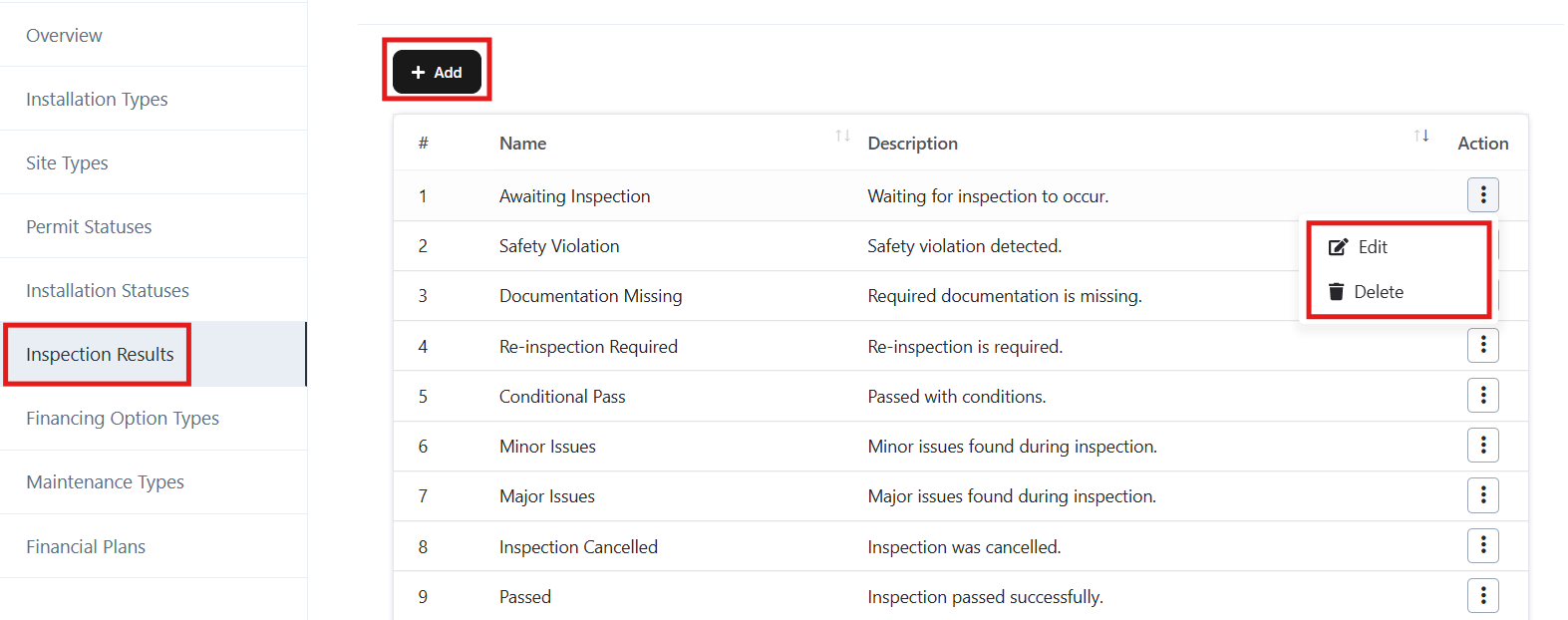
The Inspection Results section in the Solar module allows you to manage outcomes of site inspections. This ensures transparency and record-keeping for safety checks, documentation compliance, and inspection approvals. You can add new results, update existing ones, or remove outdated entries.

Why Inspection Results?

The Inspection Results feature enables businesses to:

  • Record and track inspection outcomes in a structured way.
  • Standardize naming and descriptions for consistency.
  • Identify issues like safety violations, missing documents, or failed checks.
  • Provide clarity for compliance and reporting needs.
  • Improve follow-up efficiency by categorizing results.

Login → Solar → Settings → Inspection Results → [View/Add/Edit/Delete]

Navigation Path

Accessing Inspection Results

  • Log in to the application.
  • From the left-hand menu, navigate to Solar → Settings → Inspection Results.
  • The list of inspection result will appear (e.g., Awaiting Inspection, Safety Violation, Documentation Missing).

Module Structure

The Inspection Result section includes:

  • Name – The title of the inspection outcome.
  • Description – A short explanation of the result.
  • Actions – Options to Edit or Delete a record.

Features

1. View Existing Inspection Results

  • Displays a list of predefined and custom inspection result.
  • Examples: Awaiting Inspection, Passed, Conditional Pass, Major Issues, Cancelled.

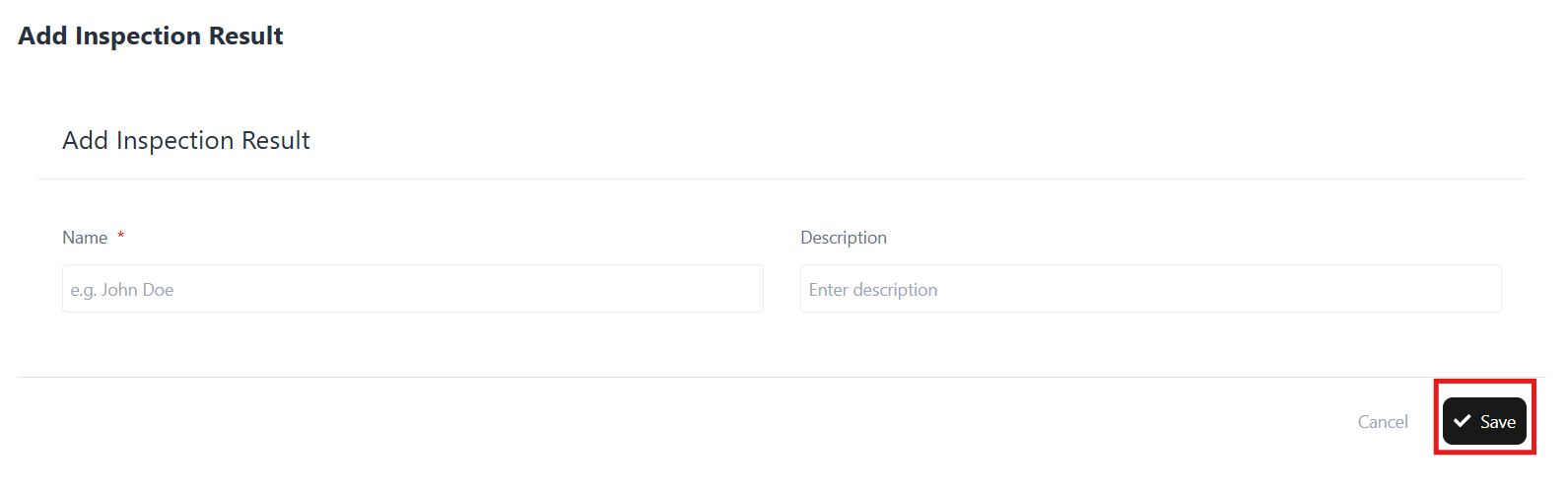
2. Add New Inspection Result

  • Click the Add button at the top of the page.
  • Fill in:
    • Name (e.g., “Re-inspection Required”).
    • Description (e.g., “Re-inspection is required due to pending issues.”).
  • Click Save to add the new result.

Add New Inspection Result

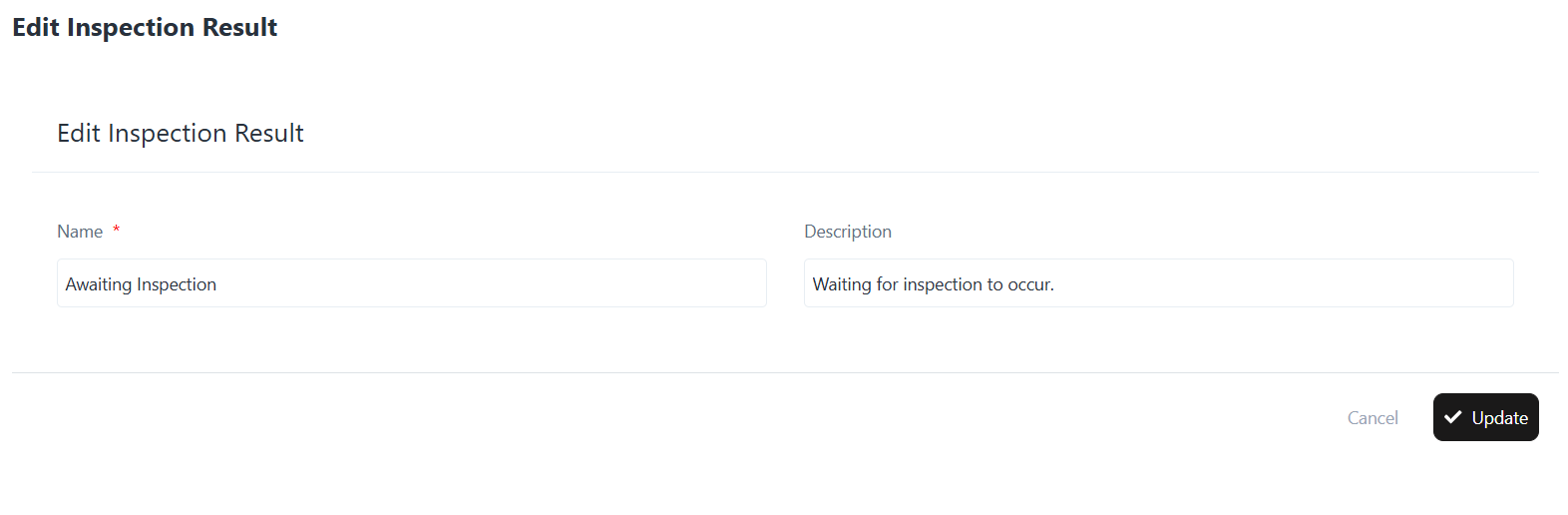
3. Edit an Existing Inspection Result

  • Locate the inspection result from the list.
  • Click Actions → Edit.
  • Update the Name or Description as needed.
  • Click Update to save changes.

Edit an Existing Inspection Result

4. Delete an Inspection Result

  • Locate the result you want to remove.
  • Click Actions → Delete.
  • Confirm deletion to remove the entry.