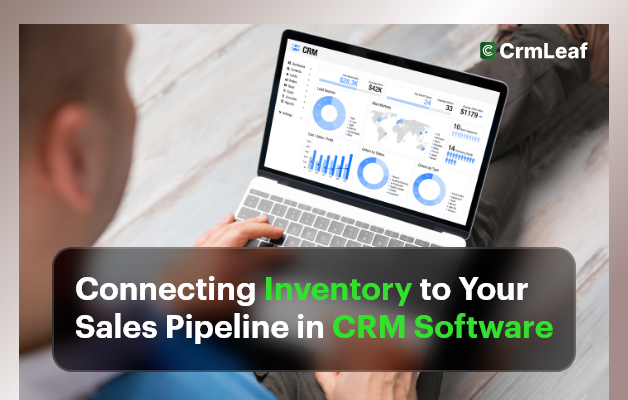
Connecting Inventory to Your Sales Pipeline in CRM Software

In today’s ultra-competitive market, 79% of mid-sized businesses cite inventory inaccuracies as a top barrier to sales growth. If your sales team promises stock you don’t actually have, you risk customer churn, lost revenue, and tarnished reputation. That’s why connecting inventory to your sales pipeline is more than an operational nice-to-have — it’s a strategic imperative.

In this post, you’ll learn how integrating your stock levels, order management, and customer data within one unified customer relationship management software platform drives efficiency, boosts sales velocity, and empowers every department — from operations to finance — to make informed decisions. Let’s dive in.

Business Need & Importance

Growing businesses often juggle multiple platforms: a standalone inventory tool, disconnected CRM systems, and maybe third-party payroll services for small businesses. This fractured setup creates data silos, manual re-entry, and blind spots:

  • Preventing Stockouts & Backorders: If sales reps can’t see real-time inventory, they overpromise to customers. Stockouts lead to expedited shipping costs, angry clients, and wasted marketing spend.
  • Reducing Manual Errors: Transcribing numbers between an online payroll services provider, a separate inventory spreadsheet, and your customer relationship management tool invites human error — leading to incorrect invoices or missed shipments.
  • Enabling Smarter Forecasting: Linking historical sales, live stock levels, and customer demand patterns in your customer relationship management software allows finance leaders to predict reorder points, balance payroll services near me, and optimize cash flow.

Industries like retail, manufacturing, and wholesale distribution especially benefit.

For example:

  • A retail chain avoids deadstock by aligning replenishment with sales promotions.
  • A contract manufacturer syncs custom part levels with client orders, reducing rush-order fees.
  • A food distributor tracks perishable inventory to lower spoilage and guarantee freshness.

Connecting inventory and sales pipelines within a unified CRM + ERP is no longer optional — it’s how ambitious small and mid-sized businesses seize growth opportunities and stay competitive.
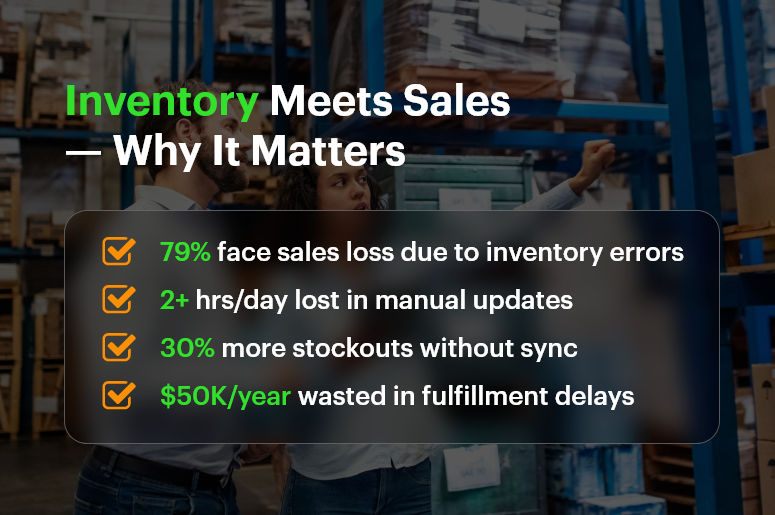
Inventory Meets Sales — Why It Matters

Best Practices & Actionable Tips

Connecting inventory and your customer relationship management software hinges on careful planning, streamlined workflows, and the right technology partner. Here’s how to get started:

Audit Your Current Workflows

  • Map every step from purchase order to shipment. Identify manual data handoffs, duplicate entries, and reconciliation tasks.
  • Highlight where your human resource management software, attendance software, or all in one HR software ties back into operations — such as labor costs in order fulfillment.
  • Pinpoint KPIs you need: stock-out rate, order processing time, and inventory turnover.

Define Clear Data Ownership

  • Assign team members who “own” data in document management, employee profiles, and document control software modules.
  • Ensure sales, warehouse, and finance each understand their input responsibilities.
  • Create data validation rules to catch anomalies — like negative stock or duplicate customer records.

Choose the Right Integration Approach

  • Native Integration: Use a combined CRM + ERP like CRMLeaf for real-time sync without custom code.
  • API-First: If you must connect legacy systems, select platforms that offer robust RESTful APIs.
  • Middleware: Employ an iPaaS (integration platform) only if you already have multiple specialized tools.

Automate Key Processes

  • Auto-reserve inventory when a quote turns into an order, preventing double-selling.
  • Trigger reorder alerts based on minimum stock thresholds tied to sales pipeline velocity.
  • Sync shipping confirmations back to your CRM systems so customer service reps can update employee profiles and track deliveries.

Establish Continuous Monitoring

  • Set up dashboards that combine unshipped orders, location-based stock levels, and upcoming promotions.
  • Leverage alerts when inventory dips below safety stock or when sales orders spike unexpectedly.
  • Integrate with online payroll services for small businesses to forecast labor needs during peak fulfillment periods.

Train Cross-Functional Teams

  • Conduct workshops where sales sees inventory live, and operations understands sales forecasts.
  • Show finance leaders how integrated data reduces the cost of payroll services for small business by optimizing staffing.
  • Develop an internal “champion” in both your human resource management systems and warehouse teams to ensure ongoing adoption.

By following these best practices, you’ll leave behind the frustrations of standalone tools — like juggling payroll services for one employee at month-end or reconciling separate document management system records — and move toward a frictionless operation.

Customer Success

For example, Apex Retailers, a mid-sized fashion chain, used CRMLeaf for connecting inventory to achieve remarkable results::

  • 30% Reduction in Stockouts: With live inventory linked to CRM systems, sales reps no longer overcommit.
  • 25% Faster Order Processing: Automated reservation and fulfillment cut manual data entry and accelerated shipping.
  • $50K Annual Savings: By optimizing labor via integrated online payroll services, Apex trimmed overtime costs during peak seasons.

Here’s how they did it: After a two-week implementation, Apex trained their sales, warehouse, and HR teams on the unified platform. They replaced clunky spreadsheets with CRMLeaf’s dashboards, synced purchase orders automatically, and linked labor costs from their best payroll service directly to order line items.

Key Takeaways & Closing

  • Connecting inventory with your sales pipeline eliminates data silos, reduces manual errors, and speeds up order fulfillment.
  • A unified customer relationship management software + ERP platform empowers teams across sales, HR, and finance with a single source of truth.
  • Adopting best practices — like automated reordering, clear data ownership, and cross-functional training — translates to real savings and happier customers.

Ready to transform your operations and drive revenue growth? A more connected, transparent workflow starts here.
Mastering Version Control: Managing Quote Revisions Without Chaos

Sales deals rarely close on the first quote. Clients ask for changes — adjustments in pricing, scope, payment terms, or discounts. Before you know it, your team is juggling five different versions of the same quote. Sound familiar? If quote revisions are eating up your time and causing internal confusion, you’re not alone. A lack of version control leads to miscommunication, errors, and missed opportunities — especially for fast-moving sales teams.

In this blog, we’ll explore how to take control of your quoting process by mastering version management. You’ll learn why proper quote revision workflows matter, common mistakes to avoid, and how CRMLeaf’s built-in version control can bring clarity and confidence to your quoting.

The Problem with Unmanaged Quote Revisions

In growing companies — particularly in industries like B2B services, manufacturing, construction, and software solutions — quotes are dynamic. Prospects negotiate, requirements shift, and pricing evolves.

But when quotes are managed via emails, PDFs, or spreadsheets, you run into real problems:

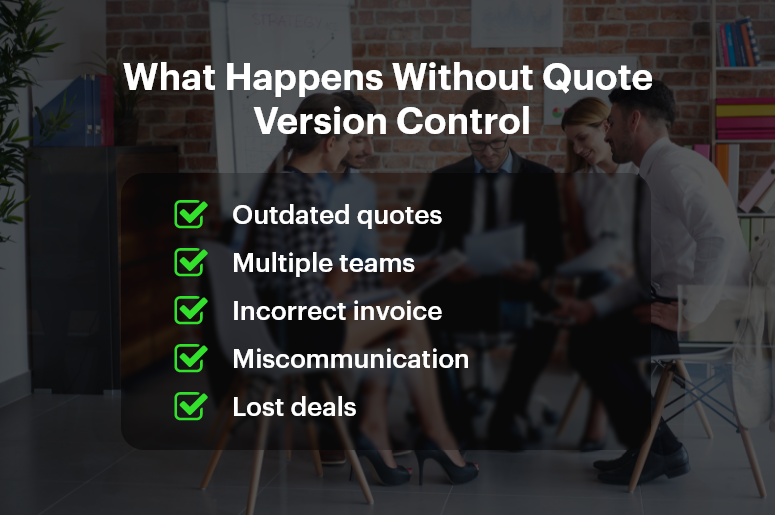
  • Reps accidentally send outdated versions
  • Managers approve the wrong quote
  • Finance generates invoices from incorrect pricing
  • Customers receive inconsistent or conflicting information

These issues aren’t just frustrating — they’re costly. A small mistake in a quote can erode client trust, delay deals, or even derail them entirely.

That’s why businesses need a reliable system to manage quote revisions — a system that ensures:

  • There’s always a single source of truth
  • Every version is traceable
  • Sales, finance, and operations are all on the same page
  • Nothing gets lost, missed, or duplicated

CRMLeaf solves this by turning chaotic quote revisions into organized, trackable, and automated workflows — right inside your CRM + ERP platform.

What Happens Without Quote Version Control

Best Practices & Actionable Tips

Here are key best practices to manage quote revisions without chaos — and how CRMLeaf helps implement each one seamlessly.

Centralize All Quotes in Your CRM

  • Why it matters:

Managing quotes through email or cloud folders leads to confusion and duplication. Centralizing all quote activity in your CRM ensures that every stakeholder is working from the same record.

  • With CRMLeaf:

All quote versions live under the associated deal or contact record. No need to dig through emails or shared drives — everything is organized and easy to find.

Enable Version Tracking Automatically

  • Why it matters:

When reps manually overwrite previous quotes, there’s no way to trace what changed. Version tracking ensures transparency, accountability, and audit-readiness.

  • With CRMLeaf:

Every quote revision is saved as a separate version with time stamps, editor names, and change logs — so you can always refer back or roll back if needed.

Label and Explain Each Revision

  • Why it matters:

It’s not enough to have multiple versions — you need context. Labeling revisions (e.g., “v1 – Initial Quote“, “v3 – Added Installation Fee“) keeps your team aligned.

  • With CRMLeaf:

Users can add comments or notes to each revision. This gives everyone visibility into why a quote was updated — critical during reviews or negotiations.

Automate Approval Workflows

  • Why it matters:

As quotes get revised, approval requirements may change — especially for discounts or custom pricing. Manual approval chains cause delays and errors.

  • With CRMLeaf:

You can configure rule-based approval workflows that trigger automatically when quotes exceed certain thresholds. This keeps deals moving without sacrificing control.

Track Customer Engagement with Quotes

  • Why it matters:

You send a quote. Then what? Without tracking, you don’t know if the customer opened it, forwarded it, or forgot about it.

  • With CRMLeaf:

Sales reps can see when a quote is viewed, how often, and by whom. This helps reps follow up with precision and close deals faster.

Maintain Security and Access Control

  • Why it matters:

Not everyone should have editing access to quotes — especially finance-sensitive revisions. Security ensures only authorized team members can make changes.

  • With CRMLeaf:

Role-based permissions let you restrict quote editing, approvals, or visibility by department or hierarchy — protecting your data and your deals.

Customer Success

For example, CoreBuild Projects, a commercial interiors company, used to manage quotes via PDFs and emails. With five project managers sending revisions manually, they often lost track of versions, sent outdated quotes, and created confusion among clients.

After switching to CRMLeaf, CoreBuild implemented structured quote revision workflows with version tagging, internal comments, and approval automation.

In just two months, they:

  • Reduced quoting errors by 80%
  • Decreased quote turnaround time by 47%
  • Improved team alignment and client trust — resulting in a 25% boost in close rates

Now, their team sends quotes faster, tracks changes clearly, and closes confidently — without the chaos.

Key Takeaways & Closing

Quote revisions are a fact of life in most sales processes — but chaos doesn’t have to be.

By implementing structured version control, businesses can reduce errors, improve response times, and close more deals. And with CRMLeaf, you don’t need to rely on manual tracking or guesswork.

From centralized quote management and auto-tracked revisions to approval workflows and deal-stage automation, CRMLeaf simplifies the quoting process from draft to deal.

Say goodbye to confusion — and hello to clarity, speed, and control.

Case Study: How GreenVolt Solar Improved Their Lead Conversion by 40% Using CRMLeaf

Generating leads is only half the battle — converting them is where the real revenue happens. Yet most small and mid-sized businesses struggle to follow up consistently, prioritize the right leads, or know what’s working and what’s not. In fact, research shows that 79% of marketing leads never convert into sales due to lack of nurturing and system gaps. This case study reveals how GreenVolt Solar, a fast-growing renewable energy company, tackled this exact problem and increased their lead conversion rate by 40% within 90 days using CRMLeaf.

Whether you manage a growing sales team or wear multiple hats as a founder, this story will show you how smart tools and simple changes can deliver real business results — fast.

The Problem: Plenty of Leads, Low Conversions

GreenVolt Solar had no shortage of incoming leads. With campaigns running on Facebook, Google Ads, and offline channels, their sales pipeline was full.

But the conversion numbers told a different story:

  • Leads were falling through the cracks due to poor follow-ups.
  • Reps couldn’t distinguish between hot and cold prospects.
  • The team used disconnected tools — spreadsheets, emails, and a basic CRM — leading to data silos and manual errors.

For growing companies in industries like real estate, solar, B2B services, or franchise businesses, this is all too common.

Without a unified system to track, nurture, and convert leads, revenue leaks happen quietly but consistently.

What GreenVolt needed was a centralized CRM + ERP platform to bring structure, visibility, and automation to their sales process. That’s when they turned to CRMLeaf.

Best Practices & Actionable Tips

Here’s a breakdown of how CRMLeaf helped GreenVolt Solar improve lead conversion step-by-step — and how you can apply the same strategies in your business.

Centralize All Leads in One CRM

The first step was eliminating chaos by integrating all lead sources — website forms, ad campaigns, walk-ins — into a single lead management dashboard inside CRMLeaf.

Why it matters:
Having all leads in one place ensures no opportunity is missed and that your sales team works from a single source of truth.

Automate Lead Assignment Based on Rules

CRMLeaf’s smart workflows allowed GreenVolt to auto-assign leads based on region, service type, or product interest.

Why it matters:
Speed matters. Leads that are contacted within the first 5 minutes are 9x more likely to convert. Automation ensures leads reach the right sales rep instantly.

Use Lead Scoring to Prioritize Follow-ups

GreenVolt implemented custom lead scoring in CRMLeaf based on actions like link clicks, form length, job role, and source.

Why it matters:
Sales teams shouldn’t waste time chasing cold leads. Scoring helps reps focus on the top 20% most likely to buy — improving conversion and morale.

Set Up Automated Email & SMS Sequences

With CRMLeaf’s marketing automation, the team launched pre-built email sequences to introduce the brand, share value props, and schedule follow-ups.

Why it matters:
Drip campaigns keep you top of mind and nurture leads over time. Even if they don’t convert immediately, they stay engaged — boosting conversion down the line.

Track Performance in Real-Time Dashboards

CRMLeaf’s dashboards gave GreenVolt visibility into conversion rates, lead status, rep performance, and deal stages.

Why it matters:
When you can see what’s working (and what isn’t), you can make informed decisions and coach your team to improve continuously.

Connect CRM with ERP Modules

GreenVolt also used CRMLeaf’s ERP features to track proposals, manage site visits, and process payments — all from the same platform.

Why it matters:
When sales, finance, and operations use one system, handoffs are smoother, data is accurate, and customers get a seamless experience — which directly impacts lead conversion.

Customer Success

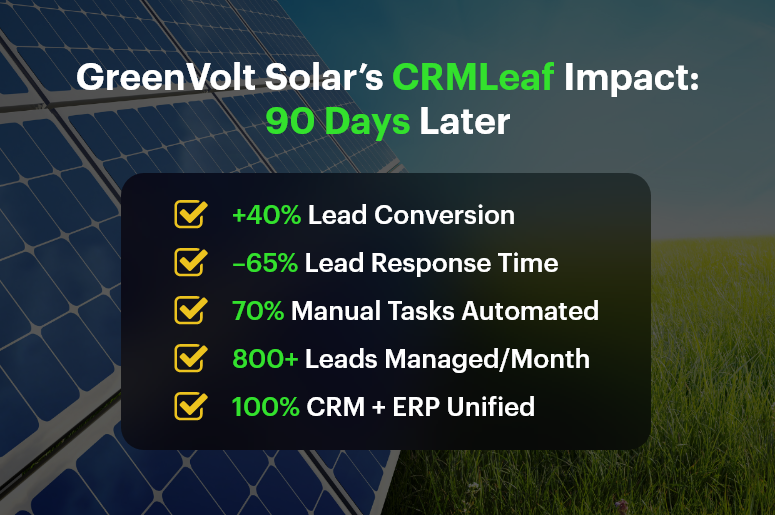
For example, GreenVolt Solar, a clean energy company based in Hyderabad, was generating over 800 leads per month but converting less than 6%. After switching to CRMLeaf, they implemented centralized lead capture, automated lead routing, and custom scoring models within the first two weeks.

They also launched a targeted email drip campaign using CRMLeaf’s built-in automation tools and synced their project site visits with the ERP module.

Within 90 days, GreenVolt:

  • Boosted lead conversion rate from 6% to 8.5% (a 40% increase)
  • Reduced lead response time by 65%
  • Increased team productivity by automating over 70% of manual tasks

As a result, the sales team was able to focus on closing deals instead of chasing spreadsheets.

GreenVolt Solars CRMLeaf Impact 90 Days Later

Key Takeaways

If your business is generating leads but struggling to convert them, you’re not alone. The key is to stop relying on disconnected tools and start using a system designed to move leads to revenue — CRMLeaf does exactly that.

From centralized lead tracking and smart workflows to automation, scoring, and ERP integration, CRMLeaf empowers your team to work smarter, not harder.

GreenVolt Solar’s 40% improvement in lead conversion wasn’t an accident — it was a result of using the right tools and strategy. And you can do the same.

How an Integrated HRMS Keeps Your People & Payroll in Sync

Are you still juggling spreadsheets, separate HR tools, and standalone payroll software? You’re not alone—many growing businesses rely on disconnected systems to manage their people and payroll. But this often results in errors, inefficiencies, and compliance headaches. According to a report by KPMG, 47% of HR leaders cite integrating HR systems with payroll as one of their biggest challenges.
That’s where an integrated HRMS (Human Resource Management System) comes in. In this blog, you’ll learn why aligning your HR and payroll under one unified system is not just a smart move — it’s essential for scaling your business efficiently.

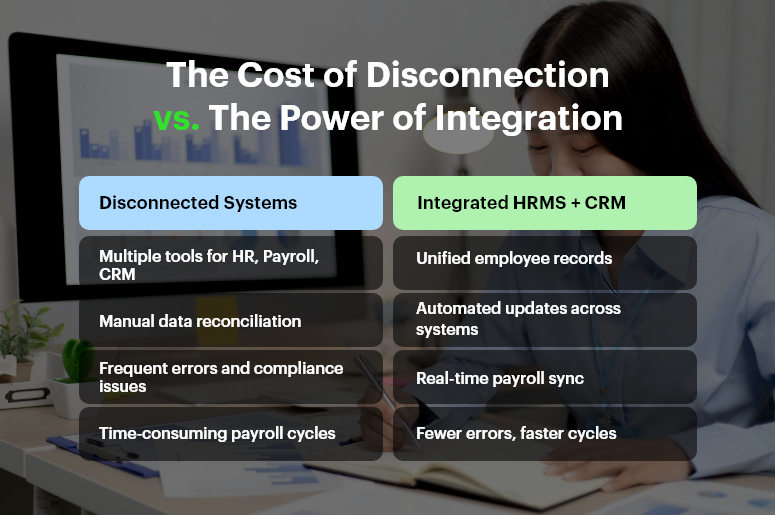
The Cost of Disconnection vs. The Power of Integration

Why People and Payroll Must Work Hand-in-Hand

As your workforce grows, so do your HR and payroll complexities. Managing multiple systems leads to data duplication, miscommunication, and payroll delays — problems that directly impact employee satisfaction and financial accuracy.

With an integrated HRMS, your business benefits from:

  • Centralized Employee Data: From onboarding to benefits and time tracking, all employee information lives in one place, eliminating manual re-entry and the risk of conflicting data.
  • Accurate and Timely Payroll: Employee roles, attendance, leaves, and benefits are automatically synced with payroll — no more month-end scramble.
  • Compliance Made Easy: Tax deductions, labor laws, and statutory filings are easier to manage when your HR and payroll are synced under one roof.

Real-World Relevance Across Industries

  • Retail & FMCG: High employee turnover and shift scheduling can cause payroll chaos. An integrated HRMS automates these processes for real-time accuracy.
  • Construction & Field Services: Managing timesheets, project-based wages, and contractual labor becomes seamless.
  • Tech & Startups: Fast-growing teams need agile systems. Unified HR-payroll platforms reduce overhead while boosting scalability.

Best Practices & Actionable Tips

How to Keep HR & Payroll in Sync Using an Integrated HRMS

Here’s how to make the most of your HRMS and ensure people operations and payroll are always aligned:

Automate Employee Lifecycle Events

Every employee event — hiring, promotions, exits — should automatically update payroll records. Promotions should trigger new salary bands, and exits should calculate final settlements without delay.

Sync Time Tracking and Leave Management

Track attendance, remote hours, and leave requests in real-time. This ensures payroll reflects the actual hours worked or days off taken—cutting down on disputes and errors.

Implement Role-Based Access Control

Maintain data confidentiality by giving the right access to the right people. Managers can approve leaves; HR can update records; Finance can process payroll — without stepping on each other’s toes.

Automate Statutory Compliance

Auto-generate PF, ESI, TDS, and tax reports with up-to-date rules. This minimizes human error, keeps you audit-ready, and saves hours of manual calculations.

Set Payroll Cut-off Dates & Auto-Schedule Runs

Define cut-off dates and run payroll on a fixed schedule. This ensures everyone gets paid on time, even if HR is managing other tasks.

Integrate Direct Bank Transfers

Disburse salaries through secure, integrated banking channels. This reduces the need for manual uploads and improves payment security.

Track Payroll Costs by Department or Project

Assign salary expenses to specific projects, teams, or departments. This gives you better budget visibility and allows for data-driven financial decisions.

Deliver Payslips and Tax Forms Automatically

Let your HRMS generate and email payslips and Form 16s. Employees can access their records any time, improving transparency and trust.

Enable Self-Service Portals for Employees

Empower employees to access payslips, update KYC, and view leave balances on their own. This reduces back-and-forth emails and saves time for both HR and staff.

Link CRM + ERP with HRMS for Complete Visibility

Unify your people, sales, and financial data in one platform like CRMLeaf. When your CRM + ERP and HRMS work together, you gain full operational transparency.

Customer Success

For example, Apex Solutions, a mid-sized logistics firm, used CRMLeaf’s integrated HRMS to bring their payroll, attendance, and leave tracking into one system.

Previously, they faced recurring payroll errors due to manual attendance reconciliation. After the switch:

  • Payroll processing time was reduced by 40%.
  • Employee disputes dropped by 60%.
  • Compliance reports were generated in minutes instead of days.

With CRMLeaf, Apex saw higher employee satisfaction and fewer administrative burdens.

Key Takeaways & Closing

An integrated HRMS is more than a convenience — it’s a strategic necessity. When your people and payroll data sync automatically, your business runs smoother, faster, and more compliantly.

By removing silos, automating critical processes, and boosting employee trust, you position your business for scalable growth and operational excellence.

Why CRM for Pharma Sales Reps Is a Compliance Game-Changer

Compliance isn’t optional in pharma sales — it’s critical. One misstep in recording a healthcare professional (HCP) interaction can lead to major fines or reputational damage. As regulations tighten globally, CRM for pharma sales reps has become essential—not just for improving productivity, but for ensuring compliant communication at every step.

According to a Deloitte study, over 60% of life sciences companies invest in CRM systems specifically for compliance tracking and field force effectiveness.

In this blog, we’ll explore how CRM solutions tailored for pharma help reps manage field activities, document HCP interactions, and remain compliant — all while boosting sales outcomes.

Business Need & Importance

Why Compliance Is the Cornerstone of Pharma Sales

Pharmaceutical sales teams operate under strict scrutiny. From FDA and HIPAA in the U.S. to global codes like EFPIA, regulations demand that every interaction with doctors, hospitals, or pharmacists is tracked, transparent, and auditable.

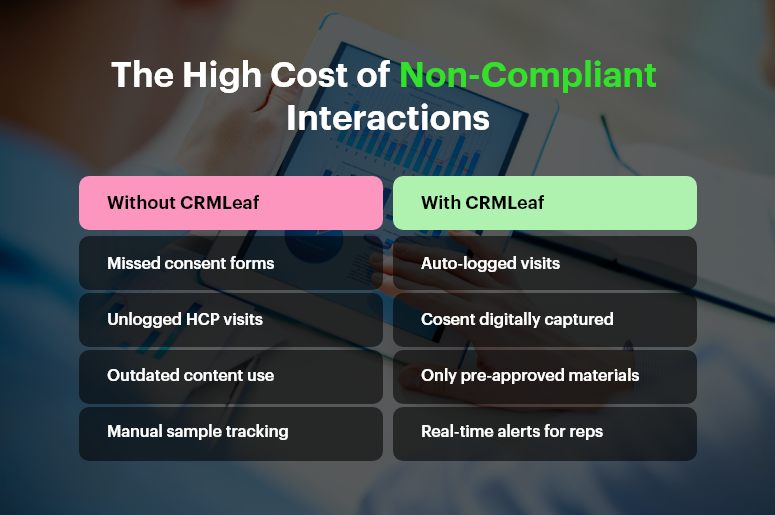
Missing even a single compliance checkpoint — such as forgetting to log a visit, sharing off-label product info, or failing to record expenses properly — can lead to legal risks or corporate penalties.

For small and mid-sized pharma companies especially, this challenge is magnified by:

  • Decentralized data entry methods like Excel sheets, paper forms, or separate apps.
  • Limited oversight into on-field sales reps’ activities.
  • Growing complexity of multi-region compliance laws.

Industries That Depend on This

  • Pharmaceuticals & Life Sciences: Where HCP interactions and promotional activities must follow strict compliance documentation.
  • Medical Device Sales: Where reps often demonstrate products on-site and must log usage and feedback accurately.
  • Healthcare Software Providers: Where CRM must track demos, onboarding, and support interactions with hospitals and clinics.

A CRM for pharma sales reps isn’t just a sales tool — it’s a compliance framework in action.

Attachment Details

The-High-Cost-of-Non-Compliant-Interactions

Best Practices & Actionable Tips

How to Ensure Compliant HCP Interactions Using a CRM

A modern CRM for pharma sales reps ensures every field activity is logged, monitored, and compliant. Here’s how to put it into practice:

🔹 Standardize HCP Interaction Logging

Ensure every call, visit, or digital touchpoint is recorded within the CRM. Reps can log visit outcomes, topics discussed, and follow-up actions in real time — reducing the risk of missed data or non-compliant exchanges.

🔹 Track Sample Distribution & Promotional Materials

Capture all product samples, brochures, and informational materials given to HCPs. CRMLeaf enables reps to select approved materials, log distribution details, and even attach digital acknowledgments — helping companies meet transparency regulations.

🔹 Set Access Controls Based on Role

Limit what reps can access and share based on compliance guidelines. Reps can only send approved documents, while managers have visibility into audit logs, ensuring materials align with regulatory boundaries.

🔹 Automate Expense Reporting with Audit Trails

Let reps record travel, meals, or sponsorship expenses with receipts attached. These entries feed into CRMLeaf’s backend reporting for finance and compliance teams — ensuring full traceability and audit readiness.

🔹 Enable GPS-Stamped Activity Logs

Use geo-tagging to verify field rep visits to clinics, pharmacies, or hospitals. This not only increases accountability but also prevents data tampering or post-entry manipulation.

🔹 Integrate CRM with Medical Databases

Link CRM to databases of HCPs, product libraries, and compliance rules. This ensures reps only interact with licensed professionals and distribute the correct drug information.

🔹 Enable Offline Access for Field Work

Reps in remote locations can log visits offline, and the CRM syncs once connected. No excuse for missed records or late data uploads — compliance stays intact even without constant internet access.

🔹 Trigger Compliance Alerts and Approvals

Set up real-time alerts for non-compliant activities. For example, flagging if a rep tries to schedule multiple visits to the same HCP in a restricted period or enters unsupported product claims.

🔹 Store Consent Records and Digital Signatures

Collect e-consent for samples, information sharing, or data usage. CRMLeaf’s digital consent logs serve as a legal backup in audits or disputes.

🔹 Link CRM with ERP for Expense and Logistics Control

With CRMLeaf’s CRM + ERP integration, expenses, inventory, and sample stock sync seamlessly. This enables end-to-end compliance tracking from budget to delivery.

Customer Success

For example, MedNova Biotech, a mid-sized pharma company with 50+ field reps, adopted CRMLeaf’s CRM for pharma sales reps to simplify their compliance workflows.

Before CRMLeaf, the team used spreadsheets and email logs to record visits — resulting in missed entries and compliance flags during audits.

After switching to CRMLeaf:

  • Compliance violations dropped by 70% within 6 months
  • Sample tracking improved accuracy by 85%
  • Audit preparation time was reduced from 5 days to just 1 day

CRMLeaf provided MedNova with a centralized platform to log HCP visits, control document sharing, and keep accurate expense records — all in one place.

Key Takeaways & Closing

A dedicated CRM for pharma sales reps goes far beyond contact management — it’s your frontline defense against non-compliance.
With CRMLeaf, your sales team can:

  • Document every HCP interaction in real time
  • Distribute approved materials only
  • Track samples, expenses, and visits with zero manual errors

In an industry where compliance and trust are everything, CRMLeaf helps your team sell confidently — without compromising regulations.

Future-Proofing Brick-and-Mortar with CRM Insights

Think retail is going all digital? Think again. Despite the rise of eCommerce, 85% of global retail sales still happen in physical stores (source). But survival isn’t guaranteed. Shifting consumer behaviors, rising costs, and fragmented operations put traditional stores at risk. To stay competitive, brick-and-mortar businesses need digital intelligence — the kind that only CRM systems can deliver. And not just any CRM. You need connected CRM insights for brick-and-mortar success.

In this blog, you’ll learn how CRM + ERP tools help retail, hospitality, and service-based businesses adapt faster, operate smarter, and serve better. We’ll break down the risks, show you what to do, and share how CRMLeaf makes the transition seamless.

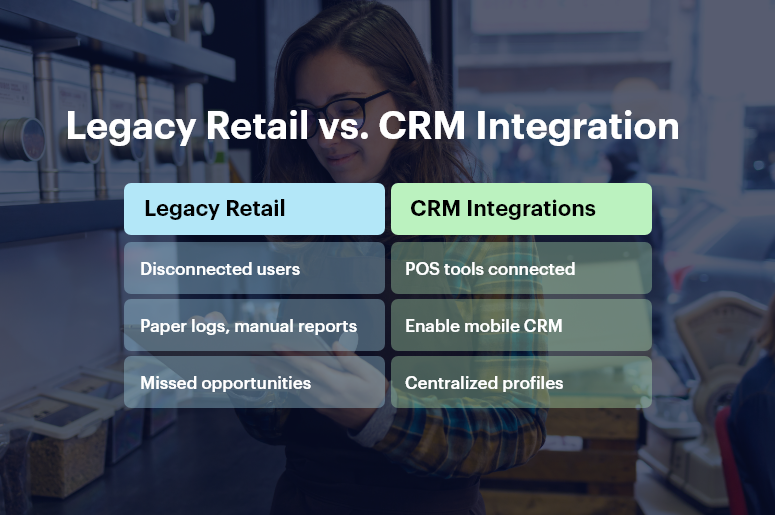
Legacy Retail vs. CRM Integration

Why CRM Insights for Brick-and-Mortar Matter More Than Ever

Digital transformation isn’t just for tech companies. Retailers, local service providers, restaurants, clinics, and franchise owners are now expected to:

  • Personalize every customer experience
  • Track inventory, orders, and service in real-time
  • Operate efficiently with smaller teams

But doing all this with disconnected tools, manual spreadsheets, or siloed teams simply doesn’t work.

Here’s why CRM insights for brick-and-mortar are mission-critical:

1. Shoppers Demand Personalization

Customers expect tailored experiences — from product recommendations to loyalty rewards. A CRM system centralizes data across POS, online, and mobile channels to build a unified customer view.

2. Inventory & Operations Must Be Agile

Supply chains are volatile. Stockouts and overstocks hurt profit. CRM + ERP helps monitor inventory across stores and warehouses, allowing real-time demand forecasting and procurement tracking.

3. Employee Productivity Impacts CX

Sales associates, front-desk staff, and service agents need fast access to customer preferences, previous purchases, and service history. CRM systems eliminate guesswork and improve in-store service quality.

4. Disconnected Tools Slow Growth

When your POS, marketing platform, and inventory software don’t talk, decisions suffer. CRM insights consolidate everything — from footfall data to sales metrics — on one dashboard.

Brick-and-mortar brands need more than foot traffic. They need foresight. That’s where CRM insights for brick-and-mortar drive real value.

Best Practices to Future-Proof with CRM + ERP

Here’s how to put CRM insights to work and modernize your physical business with confidence.

1. Centralize Customer Data Across Channels

Break silos by integrating sales, service, and marketing data in one place.

  • Create a unified customer profile that tracks preferences, visits, purchases, complaints, and feedback in one dashboard.
  • Use segmentation to personalize offers based on buying habits, location, and frequency — boosting conversion rates.
  • Enable in-store staff with mobile CRM tools so they can access real-time insights and offer better service instantly.

2. Streamline Inventory, Order, and Supply Chain Tracking

Move beyond reactive stock handling. Predict, plan, and restock smartly.

  • Set reorder thresholds with real-time stock visibility across stores and backrooms — reducing stockouts and waste.
  • Track supplier performance, order delays, and procurement costs within one ERP dashboard — saving time and money.
  • Sync online and offline channels to prevent double-selling and ensure consistent stock accuracy.

3. Leverage Footfall and Sales Data to Optimize Store Layouts

Data isn’t just for websites. Physical stores can optimize too.

  • Track in-store visit patterns, average dwell time, and popular product sections using CRM-linked analytics.
  • A/B test promotions, store layouts, and signage based on conversion metrics captured in the CRM.
  • Align staffing levels with footfall trends to ensure better service during peak hours without overspending during slow times.

4. Personalize Promotions and Loyalty Programs

Offer the right deal to the right customer at the right time.

  • Set up automated, behavior-triggered email or SMS offers based on in-store actions (like cart abandonment or seasonal purchases).
  • Reward loyalty points and send birthday/anniversary coupons directly from the CRM.
  • Track promo performance per store and segment to optimize ROI.

5. Integrate Staff Scheduling and HR into the CRM + ERP System

A productive team starts with smart staffing.

  • Build staff schedules based on traffic patterns and peak sales windows. Avoid overstaffing and under-staffing issues.
  • Track employee KPIs like conversion rates, upsell success, and service feedback using CRM dashboards.
  • Automate onboarding, attendance, and payroll integration for operational efficiency.

6. Use Predictive Analytics to Stay Ahead

Make decisions based on trends, not guesswork.

  • Forecast demand, sales trends, and foot traffic using historical CRM data combined with ERP analytics.
  • Identify customer churn risks and intervene early with personalized campaigns.
  • Optimize product placement, pricing, and promotions based on real-time CRM insights.

CRMLeaf’s AI-driven reports give real-time recommendations that improve both in-store and backend performance.

Real-World Impact

For example, a regional clothing store chain, used CRMLeaf’s CRM insights for brick-and-mortar to increase customer retention by 35% in six months.

Here’s how:

  • They centralized customer data from five locations into one CRM dashboard.
  • Automated loyalty campaigns drove repeat visits and higher basket values.
  • Inventory sync across stores cut out-of-stock issues by 50%.
  • In-store associates used tablets with CRMLeaf to upsell based on purchase history.

Result: Faster checkouts, happier customers, and a 22% increase in quarterly revenue.

Key Takeaways

  • Brick-and-mortar isn’t dying—it’s evolving.
  • CRM insights for brick-and-mortar help unify data, personalize customer service, and optimize operations.
  • CRM + ERP platforms like CRMLeaf give SMBs the tools to compete with larger chains by making smarter, faster decisions.

The future of retail, hospitality, and service businesses will belong to those who blend physical experiences with digital intelligence.