The Future of CRM: AI, Automation & What’s Next?

The future of CRM isn’t a distant dream. It’s happening now. With AI and automation transforming the way businesses interact with customers, manage sales, and streamline operations, CRM platforms are evolving fast. According to a recent study by Gartner, 60% of organizations plan to adopt AI in CRM by 2026.

But why does this matter to you?

Because staying ahead in today’s competitive market demands smarter tools, faster responses, and personalized experiences at scale. In this blog, we’ll dive into the future of CRM, what’s driving this shift, and how small and mid-sized businesses can leverage these changes to grow faster, serve better, and scale smarter.

Let’s explore the trends, tools, and actionable strategies shaping the next generation of CRM.

The Future of CRM is Now

Why the Future of CRM Matters for Growing Businesses

CRM isn’t just a tool. It’s the heartbeat of customer relationships.

And when powered by AI and automation, it becomes a growth engine.

The Business Case: Why You Need to Evolve

  • Customers expect instant, personalized experiences. A CRM without intelligence can’t deliver this.
  • Sales teams need automation to reduce manual work. Let reps sell, not spend hours on data entry.
  • Operations crave efficiency. Smart CRM systems eliminate silos and duplicate work.

Key Industries Benefiting from the Future of CRM

  • Retail & eCommerce: Personalized product recommendations and automated support.
  • Financial Services: Predictive insights on customer churn and upselling.
  • Healthcare: Streamlined patient journeys and appointment automation.

Modern businesses that want to grow can’t afford outdated tools. Embracing CRM automation and AI is no longer optional — it’s a competitive advantage.

Best Practices: How to Prepare for the Future of CRM

1. Adopt an AI-First Mindset

AI in CRM is here to stay. Start small, then scale.

  • Predictive lead scoring: Let AI prioritize high-converting leads.
  • Smart workflows: Auto-assign tasks based on behavior.
  • Sentiment analysis: Understand tone and intent in customer messages.

Tip: Choose a CRM that already includes built-in AI tools (like CrmLeaf).

2. Automate the Right Processes

Not everything should be automated. Focus on tasks that are:

  • Repetitive
  • Time-consuming
  • Rule-based

Examples:

  • Follow-up emails
  • Lead nurturing sequences
  • Data entry and duplicate checking

3. Enhance Customer Experience with Personalization

Use data to:

  • Segment your audience
  • Trigger custom journeys
  • Recommend relevant products

Next-gen CRM tools let you build smart workflows without code.

4. Enable Seamless Integrations

The future is connected.

Make sure your CRM talks to:

  • Your website & forms
  • Marketing automation tools
  • Payment systems
  • ERP platforms

With CrmLeaf, native integrations simplify your stack and reduce context switching.

5. Prioritize Real-Time Analytics

Real-time insights = faster decisions.

Track:

  • Sales performance
  • Funnel bottlenecks
  • Customer support KPIs

Automated dashboards save time and keep teams aligned.

6. Train Teams Continuously

Tech is only as good as its users.

  • Offer role-specific training
  • Create short internal how-tos
  • Encourage experimentation

A user-friendly interface helps, but so does a culture of learning.

Real-World Impact: How Companies Are Using Next-Gen CRM

For example, a mid-sized IT services firm, integrated AI-powered lead scoring and automated email follow-ups through CrmLeaf.

The result?

  • 38% increase in lead conversions within 3 months
  • 50% reduction in manual admin tasks
  • Faster follow-ups led to a 22% boost in client retention

With a smarter CRM, their sales team focused more on closing deals and less on chasing cold leads.

Key Takeaways: What This Means for You

The future of CRM is intelligent, automated, and deeply integrated with your business goals.

  • AI in CRM helps you prioritize better and personalize faster.
  • CRM automation reduces friction and boosts productivity.
  • Investing in next-gen CRM software ensures you’re future-proof.

If you want to:

  • Scale faster
  • Improve customer satisfaction
  • Empower your team

Then it’s time to act.

Don’t wait for the future. Build it.

Customer 360: What It Really Means & How to Achieve It?

Today’s customers expect more. Instant answers. Personalized service. Seamless experiences. But here’s the catch: Most businesses are still juggling fragmented systems, making it nearly impossible to truly know their customer. That’s where Customer 360 comes in.

Customer 360 means building a unified customer profile that pulls data from every touchpoint — sales, support, marketing, billing, and more. It enables your teams to see the full story behind every customer, so they can act smarter and faster.

In this post, we’ll break down:

  • What Customer 360 really involves
  • Why it’s critical for growing businesses
  • How to build it with the right tools (hint: not spreadsheets)
  • A real-world success example

Let’s dive in.

Customer-360-What-It-Really-Means-How-to-Achieve-It-2

Why Customer 360 Matters to Your Business

If you’re managing sales, support, and marketing across disconnected platforms, you’re not alone. But that siloed setup is costing you — in time, revenue, and trust.

Here’s what’s at stake:

  • Sales teams struggle with outdated or incomplete data
  • Support reps can’t see past tickets or product issues
  • Marketing targets the wrong personas with irrelevant messaging
  • Finance lacks context around deals and customer behavior

Without a 360-degree customer view, it’s like driving with a blindfold.

Customer 360 solves that.

With customer data integration, all your teams operate from the same playbook. You get:

  • A single customer view in real-time
  • Better personalized customer experiences
  • Improved cross-team collaboration
  • Stronger customer retention and loyalty

Industries like retail, SaaS, manufacturing, and even education are using CRM data analytics to make smarter decisions based on real-time customer data.

Bottom line? A solid Customer 360 foundation empowers every department — and ultimately drives growth.

How to Achieve Customer 360: Best Practices & Actionable Steps

Creating a Customer 360 isn’t as simple as merging spreadsheets. It takes a system-wide strategy — and the right CRM platform.

Here’s how to get there:

1. Centralize Customer Data

  • Connect your CRM, helpdesk, marketing tools, ERP, and billing systems
  • Sync cross-channel data — emails, chats, calls, invoices, etc.
  • Ditch manual data entry; let automation keep it clean and updated

2. Create a Unified Customer Profile

  • Merge duplicate entries
  • Assign unique customer IDs
  • Include demographics, activity history, purchases, tickets, notes, preferences

3. Map the Customer Journey

  • Identify key stages: awareness, purchase, onboarding, support
  • Align internal data to each stage
  • Highlight pain points and areas of drop-off

4. Enable Real-Time Data Access

  • Choose a customer engagement platform that updates live
  • Give every team access to the same real-time dashboard
  • Set up role-based views so each user sees relevant insights

5. Make It Actionable

  • Use CRM data analytics to surface trends, behavior, and churn signals
  • Trigger automated workflows (follow-ups, alerts, emails) based on activity
  • Prioritize leads, upsell opportunities, or risk accounts using scoring models

6. Train Your Teams

  • Run regular onboarding on how to use the 360-degree customer view
  • Encourage consistent data input and updates
  • Create a shared culture of accountability for customer context

7. Review and Improve

  • Run monthly audits of your single customer view setup
  • Eliminate duplicate entries
  • Add new integrations as your tech stack grows

With CRMLeaf, you get all this in one unified platform. No toggling between tabs. No guesswork.

Customer Success Story

BlueWave Technologies, a B2B SaaS company, used CRMLeaf’s Customer 360 view to unify data from sales, support, and marketing.

Before CRMLeaf, they:

  • Missed key follow-ups due to scattered CRM entries
  • Had marketing sending irrelevant emails to clients already onboarded
  • Couldn’t get accurate churn risk metrics

After switching:

  • They saw a 23% increase in upsell conversion rates
  • Reduced support resolution times by 30%
  • Improved NPS scores by +12 points within 3 months

Here’s how? With CRMLeaf, all teams shared a single source of truth — updated in real-time, across devices.

Key Takeaways: Your 360-Degree Advantage

Customer 360 means creating a complete, real-time, cross-functional view of every customer.

It enables personalized experiences, smarter decisions, and better retention.

Here’s what matters most:

  • Stop flying blind with fragmented data
  • Centralize and unify your customer data integration
  • Empower every team with a 360-degree customer view
  • Use tools like CRMLeaf to make it actionable, automated, and scalable

Additionally, remember that achieving Customer 360 isn’t just a tech upgrade — it’s a mindset shift. Teams must align around data transparency and customer context. With the right CRM, the transformation is not only possible, but also scalable, repeatable, and deeply impactful.

If you’re serious about customer engagement, loyalty, and growth, this isn’t optional. It’s essential.

How CRM Time Tracking Improves Project Profitability

Time isn’t just a number on the clock — it’s the pulse of your project profitability. According to a PMI study, poor time management contributes to 43% of project failures. That’s a massive profit leak. Thankfully, CRM time tracking improves project profitability by giving you the insights needed to plug those holes.

Imagine knowing exactly where your team’s hours go — which client soaks up too much time, which tasks drain your budget, and which team members are overworked. With CRM time tracking built into your ERP or CRM system, your business doesn’t just run — it earns smarter.

In this post, we’ll explore how CRM time tracking boosts profitability and how CRMLeaf can help you turn hours into dollars.

Why CRM Time Tracking Is a Profitability Game-Changer

Let’s face it — most growing businesses struggle with two big things: cost visibility and resource utilization. Without proper time tracking in your CRM, you’re guessing where your money and manpower go.

Here’s how CRM time tracking improves project profitability step by step:

  • Real-time effort insights: Get a live view of time spent per task, client, and user. Spot inefficiencies instantly.
  • Accurate client billing: Stop undercharging. Bill for every actual hour worked, not rough estimates.
  • Better forecasting: Historical time logs help you predict timelines and quote projects with more confidence.
  • Improved margins: When you estimate better and bill precisely, you protect — and grow — your margins.

Whether you’re in IT services, marketing, construction, or consulting, if you sell time, then CRM time tracking isn’t optional — it’s essential.

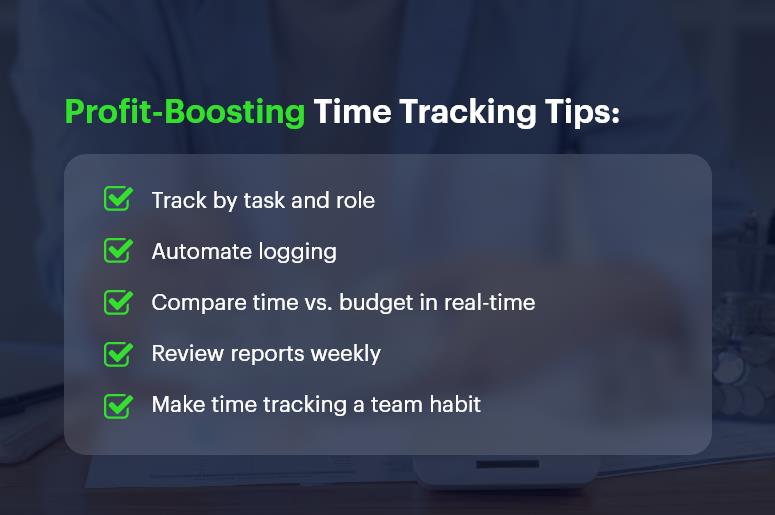
Profit-Boosting Time Tracking Tips

Best Practices to Use CRM Time Tracking for Higher Profits

1. Log Time by Task or Milestone

Don’t just log hours randomly. Attach time entries to specific tasks or deliverables. This way, you can analyze exactly what’s eating your budget.

2. Set Role-Based Time Expectations

Every role has a different billable rate and productivity expectation. Set benchmarks and compare against actuals for better cost control.

3. Track Time vs. Budget in Real-Time

With CRMLeaf, you can instantly see how logged hours compare to the original budget. If something’s going off course, you’ll know immediately.

4. Automate Time Capture

Manual time tracking leads to forgotten hours. Use built-in timers, mobile tracking, and reminders to capture every billable second.

5. Sync Time Tracking with Invoicing

Link your CRM time tracking directly to invoicing. This reduces errors, speeds up billing, and improves client trust.

6. Review Weekly Reports

Set aside 30 minutes each week to review your team’s time reports. Look for red flags and optimize as needed.

7. Build a Culture of Time Discipline

Tracking only works if everyone participates. Make time tracking a daily habit with alerts and performance reviews.

Real Example: CRM Time Tracking That Pays Off

Maxwell Design Co., a digital marketing agency, switched to CRMLeaf and instantly saw results. Before that, they tracked time manually — and inconsistently. That led to missed billing and underused resources.

After adopting CRM time tracking:

  • Billable time compliance jumped to 96%
  • Invoicing was completed 5 days faster
  • Monthly revenue increased by 18%

This wasn’t just about working harder. It was about tracking smarter — and getting paid what they were worth.

Key Takeaways

  • CRM time tracking improves project profitability by connecting time, cost, and output in one place.
  • When your team logs time by task, you see exactly how every hour affects your bottom line.
  • Billing becomes faster and more accurate, leading to better client relationships and fewer disputes.
  • Reports help you spot trends, fix inefficiencies, and improve resource allocation before things go off track.
  • CRMLeaf makes it easier with real-time time logs, mobile tracking, invoicing sync, and role-based monitoring.
  • Ultimately, accurate time tracking turns effort into income — with less guesswork and more control.

If you’re ready to start tracking time the smart way, CRMLeaf is built for you.